What is Kief Coating? The Complete Guide to Kief-Coated Pre-Rolls & Automated Coating Systems
Infused pre-rolls are dominating cannabis sales, making efficiency paramount for licensed producers. This complete guide explores the mechanics of kief-coated pre-rolls and the automated coating systems driving the industry forward. Packed with operational insights, we provide actionable advice on choosing adhesives, managing production environments, and scaling from craft to commercial output. As experts in high-throughput cannabis manufacturing automation, we break down how to eliminate manual bottlenecks, slash labor costs, and maximize profit margins using advanced technology like the CoatPRO V2.
Infused pre-rolls now dominate cannabis sales, surging 25% year-over-year as operators chase premium margins. At the heart of this boom is kief coating, a solventless process that increases potency while preserving terpenes. The result is a sticky, trichome-rich pre-roll that consumers actively seek out.
This guide breaks it all down for licensed producers, MSOs, and ops leads eyeing scalability. You'll learn what kief coating truly is and why it drives repeat buys; manual vs. automated methods (with step-by-steps); how kief coating machines operate; fixes for common headaches like shedding; machine types, including kief coating machine price ranges; and Accelerant Manufacturing's CoatPRO for high-throughput automation. Whether you're battling labor costs or pushing 10K+ units monthly, these insights position you for margin gains through consistency and speed.
What Is Kief Coating?
Understanding Kief
Kief is the powdery trichome glands sifted from cannabis flower, pure resin heads packing 50-70% THC, dwarfing the flower's 12-25%. This solventless extract shines in color: premium kief gleams light gold to off-white, signaling high purity and low plant matter.
Kief Coating Defined
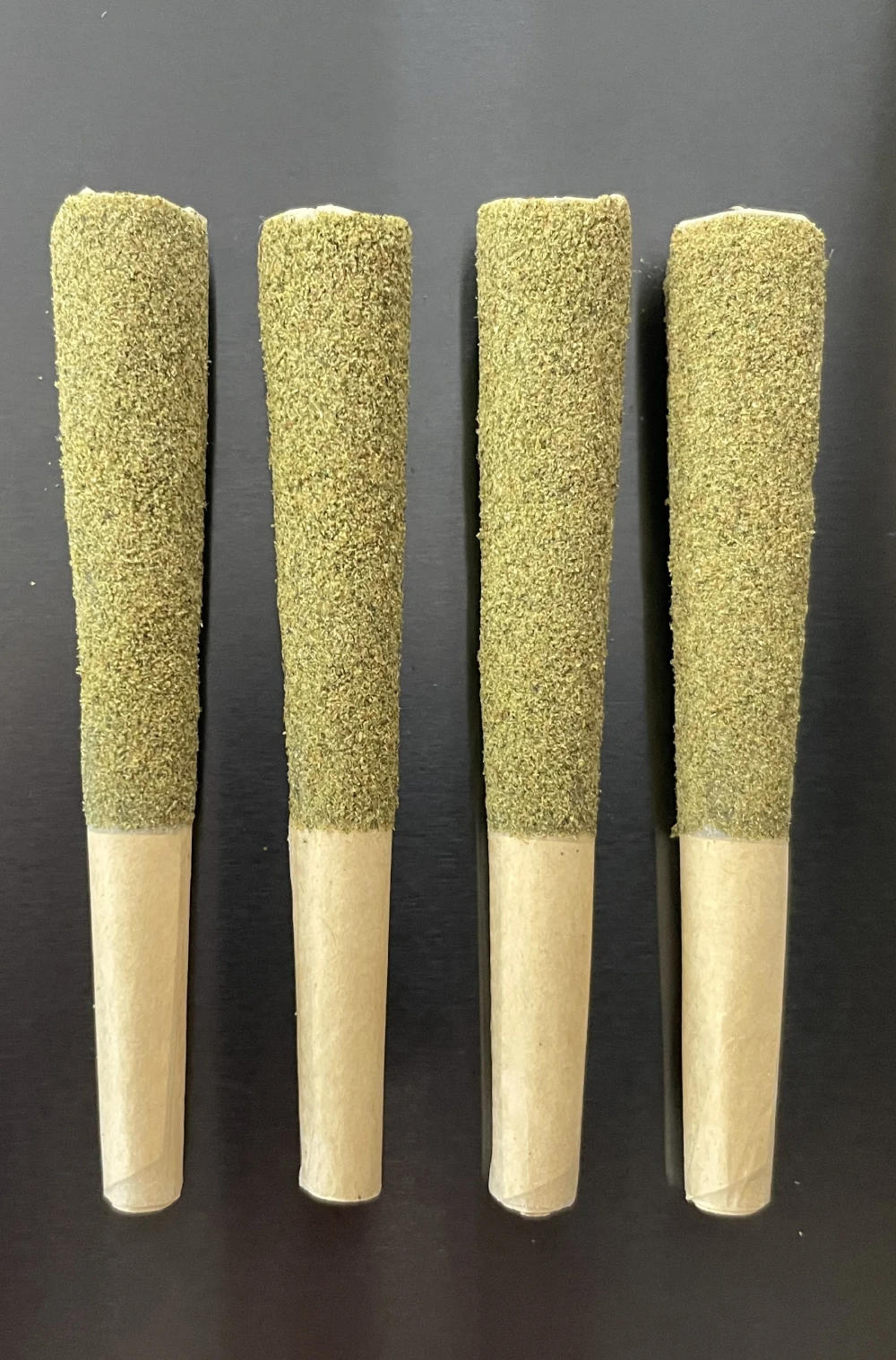
What is kief coating? It's precisely applying for external sparkle or internal potency boosts. The external method uses adhesive (distillate or rosin), then tumbles joints in kief for a frosty exterior. Inside, mix the kief into ground flower (20-30% by weight) before filling. Both preserve terpenes while spiking THC externally dazzles visually, and internally ensures even burns.
How Does A Kief Coating Machine Work?
Core Components of Kief Coating Machines
Adhesive Application System: Spray nozzles or rollers handle distillate, rosin, or gum at controlled temps (e.g., 68°F for viscosity).
Coating Chamber/Tumbler: Rotates at 20-30 RPM for even kief adhesion; sealed to trap dust.
Control System: Touchscreens save profiles, track yields, and integrate IoT.
The Automated Coating Process Step-by-Step
Load Pre-Rolls: Accommodates a wide variety of inputs, including large-format options like the PRO120 (120mm) cone spec.
Precision Adhesion & Coating: Utilizes advanced methods addressing the challenges of fluidization, spray, and confection to uniformly adhere the kief while eliminating the mess of manual sprayed/dipped SOPs.
Cure: Cures the finished units efficiently in a controlled 10-minute cycle.
Unload: Yields a minimum throughput of 1,200 consistently uniform pre-rolls per hour, achieving handmade-quality aesthetics at industrial scale.
Advanced Features in Modern Coating Machines
Expect AI vision for rejects, multi-cone sizing, and analytics dashboards Accelerant's CoatPRO leads here.
Common Problems With Coating Machines
Adhesion and Coverage Issues
Uneven kief or shedding? Blame low RH (fix: 58-62%), weak adhesive, or gritty kief. Solution: Premium dry-sift kief, calibrated sprays. Waste? Enclose chambers, train ops cuts loss by 50%.
Airflow blocks from over-kief? Dial 20-25% ratios, test draws. Hot spots? Pre-blend via GrindPRO mills.
Kief Coating Machine Options & Pricing
Types of Kief Coating Machines
Entry-Level Manual: 50-200/hour, basic tumble. Price: Quote on request. For startups.
Semi-Automatic: 500-800/hour, auto-tumble. Price: Contact for a quote. Mid-ops.
Fully Automated: 1,000-1,200+/hour, full IoT. Accelerant CoatPRO V2 exemplifies.
Accelerant Manufacturing's CoatPRO Solution
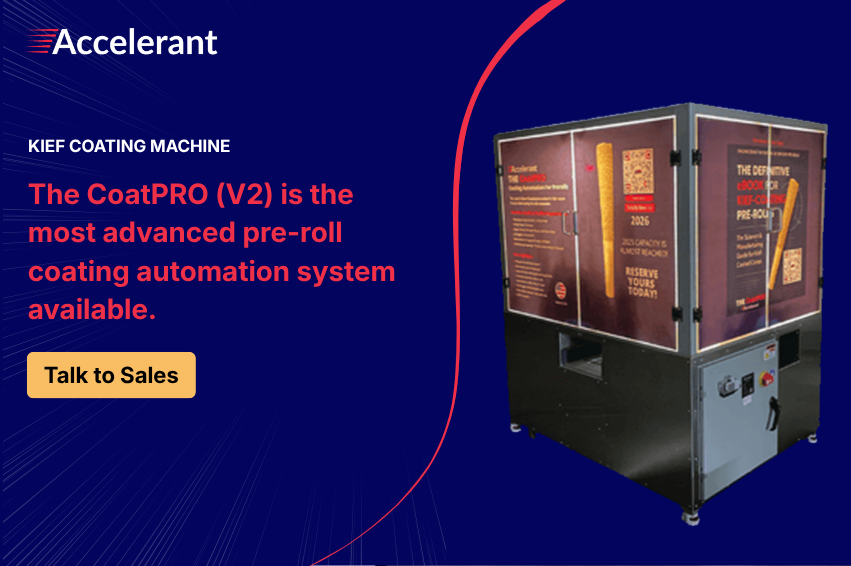
CoatPRO V2 delivers 1,200 pre-rolls/hour with touchscreen profiles, USA-made quality (Missouri), and versatile adhesives. PaaS model: Pay-per-use, zero CapEx includes training, 24/7 support, endless upgrades.
Hit Accelerant's contact form for quotes, demos at Missouri HQ, and custom plans.
Best Practices For Kief-coated Pre-roll Production
Quality Kief Selection
Premium kief shows light gold to off-white color, indicating high trichome purity with minimal plant matter avoid green-tinted kief signaling contamination. Opt for cold dry-sift methods over machine-tumbled for superior texture and potency (50-70% THC). Store in airtight glass jars at 55-65°F and <50% RH to prevent clumping or degradation; test incoming batches for microbial safety and cannabinoid consistency before production runs.
Adhesive Selection Guide
Distillate offers strong tack and added potency but may alter flavor profiles. Rosin provides a clean, solventless alternative with natural terpenes, ideal for premium solventless lines. Arabic gum suits compliance-focused ops as a water-based, cannabinoid-free option. Match adhesive viscosity to machine settings (e.g., heat rosin to 120°F), and always verify food-grade certification to meet GMP standards.
Production Environment
Maintain 65-75°F with 58-62% RH during coating and curing to optimize adhesion without shedding or mold risk. Install HEPA GMP air filters to contain kief dust, preventing cross-contamination. Use positive-pressure cleanrooms for high-volume runs, monitoring via IoT sensors for real-time adjustments.
Testing and Compliance
Every batch needs COA covering THC/CBD potency, terpene profiles, heavy metals, pesticides, and microbials. Adhere to state-specific labeling (e.g., total THC mg per pre-roll) and track via seed-to-sale software. Conduct draw tests for airflow and burn uniformity to ensure consumer safety and shelf stability.
Scaling Your Kief-coated Pre-roll Production
From Craft to Commercial Scale
Phase 1 (0-5K units/month): Manual methods suffice, focus on quality testing and niche retail partnerships. Invest in basic tools like kief sifters.
Phase 2 (5K-25K units/month): Transition to semi-auto coaters for 500-800/hour throughput; hire dedicated ops leads and standardize SOPs. Expand SKUs with infused variants.
Phase 3 (25K+ units/month): Deploy CoatPRO V2 + PRO2 filling systems for 1,200+/hour; run multi-shifts with analytics-driven optimization. PaaS model scales without CapEx spikes.
Choosing the Right Time to Automate
Automate when hitting 10K+ monthly demand, labor exceeds 30% of COGS, manual inconsistencies spike rejects >5%, or retail partners push volume contracts. Calculate breakeven: CoatPRO pays off via 75% labor cuts at scale. Audit current throughput vs. growth projections quarterly.
Implementation Strategy
Start with a facility assessment to ensure 500+ sq ft, power upgrades, and airflow compliance. Develop SOPs during 1-week pilot training; phase rollout (e.g., CoatPRO first, then PRO2 integration). Benchmark against Hefestus/RollPros metrics, iterating via production data for 20% monthly efficiency gains.
Future Of Kief Coating Technology
Emerging Trends
AI vision systems auto-reject defects at 99.9% accuracy, slashing QC labor. Blockchain enables end-to-end batch traceability for compliance audits. Strain-specific profiles optimize kief ratios via machine learning; expect customizable patterns like spiral coating for branded appeal. Sustainability tech recycles 95% of kief waste into edibles.
Innovation at Accelerant Manufacturing
PaaS delivers perpetual upgrades like IoT remote monitoring (real-time alerts via app), advanced vision AI for sub-micron defect detection, and Industry 4.0 integration with ERP systems. CoatPRO V3 roadmap includes robotic loading and predictive maintenance, keeping MSOs ahead of competitors like PreRoll-ER in nationwide scaling.
To Summarize
Kief coating supercharges potency and premiums; automation like CoatPRO ensures scalability and ROI for 10K+ units/month. Ditch CapEx with PaaS. Ready to scale infused pre-rolls? Schedule a CoatPRO V2 demo at our Missouri facility. Contact Accelerant today for specs, pricing, and plans.
Frequently Asked Questions
How much does a kief coating machine cost?
Entry-level manual systems start with custom quotes for small ops (often under $50K for basic setups), while semi-automatic models range $100K-$250K depending on capacity. Fully automated solutions like Accelerant's CoatPRO V2 avoid upfront CapEx entirely through the PaaS pay-per-roll model, ideal for scaling without debt. Pricing factors in throughput (1,200+/hour), features like IoT analytics, and add-ons; request a tailored quote via Accelerant's site for exact figures based on your volume.
Can I use the same machine for different types of coating materials?
Absolutely versatile machines like CoatPRO V2 handle distillate, live resin, rosin, THCa, hash, or even Arabic gum via programmable profiles and adjustable spray systems. Switch materials seamlessly with temperature controls for viscosity and quick-clean chambers, minimizing downtime. This flexibility supports diverse SKUs, from solventless kief-coated to hybrid infused pre-rolls, while maintaining compliance.
How long does it take to train staff on automated kief coating machines?
Training typically takes 1-2 days for CoatPRO systems, thanks to intuitive touchscreen interfaces and on-site support from Accelerant. Operators learn loading, profile selection, and troubleshooting quickly; comprehensive sessions cover maintenance and analytics. For larger teams, remote modules extend to a week, ensuring 1-operator efficiency at full 1,200/hour capacity with minimal errors.
What production capacity should I expect from an automated kief coating machine?
Expect 1,000-1,200+ pre-rolls per hour from top fully automated systems like CoatPRO V2, with single-operator runs handling 120 mm cones. Entry-level hits 50-200/hour, semi-auto 500-800; scale via multi-shifts for 10K+ daily. Factors like cone size and adhesive type influence output. Modular designs allow expansion without new purchases.
Is kief coating compliant with cannabis regulations?
Yes, kief coating fully complies when using approved solventless materials and food-grade processes, aligning with state regs like California's Manufactured Cannabis Safety standards (defining kief as separated trichomes) and NY's processor guidelines. Ensure COAs verify potency/purity, GMP environments, batch traceability, and proper labeling; no added solvents needed. Accelerant systems support compliance with enclosed designs and data logging.
What is the difference between kief-coated and kief-infused pre-rolls?
Kief-coated pre-rolls apply kief externally via adhesive for visual sparkle and surface potency (40-70% THC boost), ideal for premium appeal but prone to minor shedding. Kief-infused mixes kief directly into ground flower (20-30% ratio) for even internal distribution, smoother burns, and no fall-off, preserving terpenes without harshness. Coated dazzles retail; infused excels in consistency for high-volume sales.
ABOUT THE AUTHOR
Enjoyed this read?
Stay up to date with the latest cannabis business news, strategies, and insights sent straight to your inbox!
Thank you! Your submission has been received!
Oops! Something went wrong while submitting the form.
Enjoyed this read?
Stay up to date with the latest cannabis business news, strategies, and insights sent straight to your inbox!
Thank you! Your submission has been received!
Oops! Something went wrong while submitting the form.




.png)
.png)